Sunday, July 5

Lack of intelligence

Today the broadcast media are leading on the Mail "scoop" that the future head of MI6 had personal information published on Facebook.

The Conservatives are expressing concerns over the security implications. The Liberal Democrats are more hysterical, calling for a public inquiry.

Bizarre.

Why do we need an inquiry? What would it achieve?

Reading the Mail article, it appears the facts are fairly straightforward: the wife of a diplomat posts personal photos and other information on a networking site; she doesn't apply adequate privacy settings; an opportunistic journo spots the lack of privacy and manages to squeeze a splash out of it.

The information which raises security concerns include: "family holidays"; "showbiz friends"; and [tenuous] "links to David Irvine".

It is possible an opportunistic terrorist might use these to exploit the head of MI6, but I suspect even if the information wasn't available on Facebook that someone with the will and means might be able to find out such information anyway.

So an inquiry seems to be completely pointless, both in what it would discover and what it would achieve.

Perhaps we should have a public inquiry into the Liberal Democrats' opportunism?

The incident raises questions about online privacy in general and our own responsbilities in policing what information we share with the world. But it is not the earth shattering news the Liberal Democrats would have you believe.

David Miliband put it well when he spoke about the matter this morning:
"Are you leading the news with that? The fact that there's a picture that the head of the MI6 goes swimming - wow, that really is exciting. It is not a state secret that he wears Speedo swimming trunks, for goodness sake let's grow up."

Thursday, June 18

Climate strange

Hilary Benn outlined climate change projections in Parliament today. The question remains why he made the announcement at all.

In October 2008, Gordon Brown announced the creation of a new department to tackle the issue of climate change - the aptly titles Department for Energy and Climate Change (DECC). Ed Miliband was installed as its first Secretary of State.

The department took some responsibility from BERR (mainly energy issues) and others from DEFRA (climate change).

So you would have thought that DECC would be responsible for things such as reports on the impact of climate change.

If you are on the DECC website, it appears they are. Not so say the DEFRA website: they are. (There is even a his and his video introduction from Ed Miliband and Hilary Benn, on their respective websites).

A charitable explanation might be that DECC look at climate change, whereas DEFRA manage its effects.

Even if that were true, it invites the question as to why the two departments are not even more closely integrated? For instance, their functions being part of the same department?

The UK government has been relatively more pro-active about environmental issues than most countries. But there is no reason why a separate department is required for climate change - particularly if the environment department works on the same issues.

The DECC/DEFRA split looks, in hindsight, like wasteful and inefficient duplication.

To say nothing about the abilities of the incumbent Secretaries of States, DECC and DEFRA should be merged.

Tuesday, June 16

Labour pains

The UK labour market has shown surprising flexibility, which should help during a recovery.
Today British Airways announced that it was asking workers to work for free, or take unpaid leave, in a bid to cut costs. Other companies are doing the same: for example, business services firm KPMG recently asked staff to consider unpaid leave and Honda shut down factories for months.

This helps businesses retain skilled employees during the downturn, but simultaneously reduces their wage bills. Not all businesses have had that luxury - many have made staff redundant, or closed completely.

The appetite amongst workers for such schemes underlines the flexibility within the UK labour market, in contrast to previous recessions and more rigid labour markets elsewhere. And retaining skilled workers mean gearing up for a recovery should be easier, quicker and less costly for business than letting staff go.

New unemployment figures are out tomorrow. They are likely to show another jump in the number of people looking for work. It'll be scant consolation for the newly unemployed that the situation could be much worse.

Saturday, June 6

State of the Union

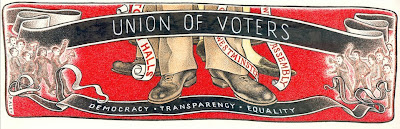
The people behind 18 Doughty Street and ConservativeHome have set up a union. No, really.

An email dropped into my inbox the other day - it had obviously been mail-merged as they had spelt the site name incorrectly - with information about a new union: a union of Voters.


The "union" has four manifesto commitments:
  1. There should be no such thing as a 'safe seat for life' - voters should be able oust any MP in whom they have lost trust.
  2. There should be referenda when all the establishment politicians agree but the people don't.
  3. Political parties should look to voters for their funding, not big business, big unions or big government.
  4. Politicians should not be able to hide their expenses, income and connections from voters.
Some of these points are difficult to argue against, and are perhaps trivial as a result. The one on funding might disadvantage Labour compared to the Conservatives given the spending power of their respective traditional constituencies.

What is really interesting is that its founders - of the right and centre-right - have appropriated the language of the left in order to establish a (rather modish) movement against the political class. A tacit admission of the value of unions?

The site aims to be like the MoveOn movement in the states, but in typically British fashion looks a little staid from the off. It'll be interesting to see if this union becomes a tour de force in British politics...

Saturday, May 23

Mountains and molehills

The Economist's leader about expenses-gate is well worth a read this week, and makes some salient points:
There may indeed soon be good reasons for forcing an election—especially if it becomes obvious, as it well might, that Gordon Brown’s spindly government has lost the authority to govern the country. But the expenses crisis, if anything, weakens the argument for a contest now. If an election were called next week, Britain might well end up with a Parliament for the next five years that is defined entirely by its views on claiming for bath plugs, rather than on how to get the country out of the worst recession in 70 years.

The same yes-but-not-now logic applies to the calls for constitutional reform. Some elements in this crisis can indeed be traced back eventually to defects in Britain’s system, notably the drift of power away from Parliament to the executive. But the heart of the matter was much smaller: a shoddy way of dealing with expenses. You could re-engineer great swathes of Westminster—bring in an elected House of Lords, introduce a Bill of Rights, design open primaries for MPs, scrap the first-past-the-post electoral system—and it would not make a shred of difference if the people elected were left in charge of claiming their own expenses amid a “course-you-can-chum” culture. A pile of swimming-pool-cleaning receipts is not a good starting place for constitutional reform.
More here.

Tuesday, May 19

Speakeasy

The Times appear to imply the Speaker of the House, Michael Martin, is a drunk today. The ritual humiliation the man is being put through is unfair, and misses the point.
Michael Martin isn't the best orator this country has ever produced - you only need watch his statement yesterday to see that. Nor may he be the most qualified to act as Speaker (although I don't feel expert enough to opine on this).

But the opprobrium heaped upon him by fellow MPs defies belief. They may think that sticking the knife in one of their own may in some way make up for their collective failings - like a sacrificial expenses lamb.

However, the electorate is likely to meet out a harsher, more visceral punishment at the next national poll. Such is the problem with accountability.

Monday, May 18

Showbusiness for ugly people?

First Lumley, now Rantzen and Carson. "Celebrities" should probably stick to the day job.

I'm all for people being interested in politics, but why is that those who build a celebrity career in the entertainment industries always feel the need to get involved in politics?

Sometimes their interventions can be beneficial, although oftentimes they look a little out of their depth, or do serious damage to their reputations. When backing political parties or campaigns, they are often used. Even independents, like Martin Bell, can go a little native.

They say that politics is "showbusiness for ugly people". And, particularly of late, it is not just politicians' looks, but also their moral compasses which look disfigured. 

Those in real showbusiness would probably be better off well out of it.

Tuesday, May 5

Assets and liabilities

Brown promised a "government of all the talents". Why doesn't he show them off more?

Tonight Labour kicked off the party election broadcast season in the run up to the local and European elections on June 4th. Nothing remarkable in that. But what was remarkable was the fact that the only member of the government to appear in the 3 minute video was ... Gordon Brown.*


When Gordon promised a government of all the talents, I hadn't realised he meant just himself. What about David Miliband or Straw? Smith or Johnson? Mandelson or Benn? What about Alexander or Hutton? Harman or Blears? Hoon or Balls? Ed Miliband or Purnell? Woodward or Baroness Royall? What about Burnham or Denham? Cooper or Murphy? (And that's before we even get to the GOATs.)

It is understandable that Labour wish to emphasise Gordon's economic credentials by focusing on him in a broadcast about the recession. But such a strategy is doubled-edged: if voters buy the line that the UK is well placed in the current recession thanks to Gordon, then Brown is the primary beneficiary; if they don't, they'll blame Gordon, not necessarily the government.

Would it not be better to show a unified cabinet out and about sorting out the recession? Working together to make life better for all? Interspersed with shots of Gordon speaking at G20 and Congress, to emphasise his leadership credentials, this would surely have made for a more compelling narrative.

For someone so economically and commercially tuned, his party election broadcast suggests Brown has confused Labour's assets and liabilities.

*The back of Alistair Darling's head got a cameo.

Monday, May 4

Debatable

Brown's YouTube disaster highlights the importance of style, as well as of substance

Hopi Sen blogs that Brown should debate Cameron in the run up to the next election in response to a post by Danny Finklestein. Sen thinks these debates will generate more attention on policy, where Cameron is weak, thus boosting Labour's chances. Finklestein argues that Cameron doesn't have much to gain by debating Brown, so shouldn't bother.

They are both wrong. 

While I agree that debates will allow more time for policy detail than would otherwise occur in an election campaign, I remain unconvinced that such a forum would benefit Brown. His YouTube appearance last week emphasised how uncomfortable he is communicating policy (although in this case the policy was not thought through either). Cameron, a former PR man, is far more polished on his WebCameron videos and will likely do well in any televised debate.

A live debate is therefore a danger to Brown. Remember Kennedy-Nixon 1960?

It is for this reason that I think Cameron would benefit from a debate - it would take a lot for Brown to convince voters, even if his policy detail was impeccable. He has much to lose. Cameron does not.

That all said, if the debates were structured such that ministers and shadow ministers debated detailed policies, leaving Brown and Cameron to fight it out over the big picture narrative, then this might work to Brown's advantage: while Cameron has detoxified the Conservative brand, not all shadow cabinet ministers are so endearing; and, while the focus is on others, Brown is, ironically, less likely to lose votes.

Such talk may be academic, however, given there is so much debate over whether there should even be a debate.

Friday, May 1

Brown and out

April is over. And with it, surely, Labour's re-election hopes at the next national poll.

They say it never rains, but pours. For Gordon Brown, April - with its attendant showers - has been torrential. First 'porno-gate', then 'smear-gate', then 'smiley-You Tube video-gate', and, finally, 'budget-gate'. No wonder that Labour's poll ratings are collapsing faster than Britain's house prices.

It is almost inevitable that the electorate will tire of the same old faces - Gordon's looks older by the day - and that the press will ignore policy in favour of tittle-tattle about expenses claims for porn, and the like. But the current lot don't do themselves any favours.

A lot of the policy and posturing at the minute looks party political. To an extent, this should be expected - Labour is a political party. But the actions of Brown et al recently nods to a more guileful bent - one that places political maneouvering above the object of government.

This is a shame. One of the great achievements of the Labour government was attention on outcomes, without so much emphasis on means. Now the balance is shifting in the other direction - for example, the Budget was miserly, but gave the appearence of a triumph for the working man over his baron paymasters (in truth, a 50% top rate tax band will generate comparatively little compared to the duty hikes in the budget which will hit lower income earners).

Tony Blair once said that: "Power without principle is barren, but principle without power is futile." On the basis of the past month, Labour will end the next election with neither.

Saturday, January 3

VAT are you talking about?

Cameron and Clegg get it wrong on VAT.

Nick Clegg today joined David Cameron in attacking the VAT cut as "a waste of money" (DC said something similar yesterday).

It hardly takes a single-celled organism to realise that a cut in VAT results in HMRC receiving less income - the Government does not pay for a sales tax cut through general taxation.

Therefore NC and DC are essentially arguing that consumers are wasting the money they are not giving to the goverment (presumably by saving it), and that government would spend it better if only consumers weren't able to keep it.

Most bizarre.

Friday, November 28

The grass is always Green

Damian Green's arrest reflects badly on all political parties and their politicians. It also raises questions about the common law offence of misconduct in public office.

Apparently arresting a publicly elected legislator is a sign of a "Stalinesque" state. I would suggest shooting them more so. Let's make no mistake, the arrest of Damian Green - the Conservative's Shadow immigration spokesperson - is a grave affair. But not for the party political reasons we're likely to hear much of over the coming days.

The real issue surrounds the common law offence of "misconduct in public office". The offence was introduced post-Hamilton following a recommendation by the Nolan Committee on standards in public life, and has been used in the past to prosecute, for instance, police officers who have sex whilst on duty.

Let's be clear: Damian Green is not accused of misconduct in public office. He is accused of "aiding and abetting misconduct in public office" - i.e. helping someone else commit an alleged offence.

That individual is the unnamed civil servant who appears to have been passing information about the Home Office to Damian Green, which Green subsequently passed to the press. It is unclear to me what the "aiding and abetting" could have consisted of, if not the act of supplying that information to the press.

It is perhaps a bit rich for Damian Green to have criticised the Government earlier in the year over leaked documents, especially if he actively solicited those documents from a helpful insider.

But that isn't justification for arrest. Misconduct in public office is proven on the basis that an act "amounts to an abuse of the public's trust in the office holder" (amongst other things).

Does passing confidential documentation which the government of the day are witholding from the public amount to an abuse of the public's trust in that office holder?

On one hand, I can see the arguments which suggest it is - someone who more often acts against their employer, than for them is a liability. Nonetheless, the public should expect that information is not deliberately withheld from them by the politicians they elect.

I expect the Conservative party will make some ridiculous statement about erosion of civil liberties in the wake of this arrest. No doubt they will call for resignations. Perhaps Labour will too. Nonetheless, the fact that it has happened, and on Labour's watch, makes this a rather sorry affair for the Government.

The real question, however, is whether the misconduct in public office offence is being appropriately used. On the evidence of this arrest, I suspect not. And there are other ridiculous examples - such as affairs by politicians being investigated under that offence.

It appears to me that, when it comes to misconduct in public office, the letter, rather than the spirit of the law is being applied all too often.

Wednesday, November 26

Woolworthless

The news that Woolworths has entered administration is hardly a surprise; the chain had ceased to be relevant in today's crowded high street.

I remember visiting Woolworths as a child and being struck by just how much tat can be crammed into one store at any one time. Its strength in days of yore became its achilles heel in the modern world: variety of product lines.

Woolworths is the retail equivalent of a 'jack-off-all-trades, master-of-none'. Schizophrenic in the extreme. It sold everything at once and - as we've found out today - not much at all. Competitors in all of its chosen markets - DVDs, books, clothes, homeware etc - typically did it better, if not cheaper.

It is all too easy to get sentimental about brand names. Yet if a business is not a going concern, then what can be done? Times change. The high street moves on.

The likely job losses so soon to Christmas are the real shame in all of this. For all the rubbish it sold, Woolworths employed a massive number of people - 25,000 according to reports. Let's hope as many of those can be saved as possible. Or that those who lose their jobs - as seems inevitable for many - manage to find new employment soon.

Monday, November 24

VAT was all the fuss about?

Conservatives and their supporters bemoan a cut in VAT. Why?

It is a rather perverse state of affairs when Labour, not the Conservatives, champion tax cuts (albeit temporary ones). Of the policies in today's pick 'n' mix PBR which seemed to incur the greatest ire of those on the right - judged by blog reaction, and the collective animal noises of those on the opposition benches - was the cut in the rate of VAT from 17.5% to 15%.

The principle argument in opposition to the VAT cut is simply that it will not work: a 2.5 percentage point cut in a sales tax is hardly likely to spur consumer spending enough to stave off a sharp recession; business won't pass on the cuts, but boost profits (or at least revenue) instead; the costs to business to factor in the changes will dwarf the benefits of making the cut etc.

This all misses the point. And the Conservatives are missing a trick.

Economically, the policy makes sense - sales tax is regressive and provides a channel through which consumer spending will be directly stimulated (assuming cuts are passed on to consumers), rather than tax rebates which are typically used to save or pay off debt (just look at the US experience from earlier this year - and they are now proposing another fiscal stimulus 25 times our own). Even if business does not pass the cut on to consumers in full, it won't hurt their profit margins in the current climate (and hence their ability to continue employing staff who can themselves continue to spend).

Plus the argument often levelled at the measure - that a change in price from 99p to 97p won't be enough to modify consumer expenditure - ignores the cumulative effect of a VAT cut. The PBR itself suggests that the measure will cost the taxpayer £8.6bn next year - not inconsiderate for a marginal cut in VAT. Cumulatively, the measure may save the average household between £250 and £500 a year. Again not inconsiderate, and more likely to be spent than tax rebates.

But that is besides the point. The Conservatives shouldn't oppose the measure on the basis that it may not work. They should embrace the measure as a cut in an unnecessary and unfair tax (surely a desirable aim for the Conservatives?). Moreover, cuts in VAT are consumer friendly - particularly to those on lower incomes. All parties should commit to maintaining VAT at the lowest possible level under EU VAT area rules - the 15% should remain beyond the end of 2009.

If the Conservatives did so, DC and GO can claim to be both tax-cutting and friendly to the poorest in Britain in one fell swoop. The opposition to VAT may serve a short-term political objective, but it will make it difficult for the Conservatives to emphasies any tax-friendly credentials in future.

PS It was interesting to note the reaction over the weekend to the interview with Kenneth Clark in the Times:

"We can expect to see a lot of Ken Clarke over the next few days; the Tories know that he is still on of their most convincing voices on the economy. His interview in the Times today is helpful to the Tory cause. But it is worth noting that he breaks with the leadership in endorsing the idea of a stimulus package albeit one of a very different stripe from the one Brown and Darling are said to be planning, Clarke favours a temporary reduction in VAT to 15 percent." (emphasis added)

James Forsyth, Spectator Coffee House Blog, 22nd November 2008

Oops.

Sunday, November 23

Offside

Is it fair that football clubs owing millions of pounds to HMRC can write most of it off by going into administration, without necessarily incurring commensurate league penalties?

I ask the question because the Donal MacIntyre programme have done a special on the unpaid tax bill of clubs who have recently entered administration - some £28m by their calculations (which is in a statistical error as far as government is concerned, but that seems moot).

As a Leeds United fan my views are shaped by experience rather than strict logic. I agree that it seems unfair that, as Alan Sugar put it, "Leeds spent millions and millions of pounds, go bust and the following Saturday start again".

But should clubs who go into administration be thrown out of the football league, instead of incurring a points penalty as at present?

I don't know what purpose that would serve, except to get get one over on long-standing rivals. Leeds United were relegated twice in just a few years, sold their stadium and lease it back, now languish in League One, and have had to assemble an entirely new team mainly through reliance on free transfers and youth players. 

Hardly "starting again". Going bust was in no way the best thing that happened at Elland Road, except that financial security now seems to be a principle aim of the club. The couple of years of Champions League action were evidently not worth the price Leeds have subsequently paid.

That an increasing number of clubs enter administration implies a symptom of a deeper problem, probably the increasing inequality in revenue between clubs in the Premier League and those in lower leagues.

To be successful today, clubs have to spend. And to be really successful, clubs have to spend a lot. Premier League TV deals have increased the pressure on all clubs in terms of cost of players, and wages. As a result, costs have risen far faster than gate receipts for many clubs. But without spending, teams cannot guarantee footballing success which potentially increases revenues.

That footballing debts are honoured at 100% when a football team goes bust whereas non-footballing debts are not is anomalous. But the wider rules of administration - that clubs coming out of administration pay less than 100% of the debt owed - should not be changed just for football clubs.

Kicking clubs when they are down in the way Sugar suggests doesn't help address wider failings in football league management. The Football League should put appropriate measures in place to ensure that clubs do not put themselves into financially precarious positions. 

One suggestion may be to apply points penalties to clubs whose wage bill exceeds a certain ratio of revenue. Whatever, more can and should be done to ensure clubs do not go into administration, instead of applying additional and harsher penalties when they do.

Saturday, November 22

The PBR and VAT

Speculation is mounting of a deferred increase in VAT to pay for a borrowing splurge. That could be politically indefensible from a Labour chancellor. 

The Spectator's Coffee House blog today picks up a blog post by Robert Peston about Monday's Pre Budget Report, in which Peston predicts:
So which taxes will rise?
Well my prediction is VAT.
For the sake of transparency I should say that I don't know that there will be a VAT rise.
But a deferred increase from 17.5% to 22.5% in the VAT rate would raise around £20bn.
And it's one of the few future tax rises which might actually stimulate a bit of increased economic activity ahead of its implementation, rather than encouraging us to save.
To use the economic cliche of the moment, it would give us all quite a "nudge" to spend now, before the swingeing increase in VAT would kick in.

Sales taxes are regressive taxes - those on lower incomes tend to spend a higher proportion of their income on goods and services, and so spend more on VAT as a proportion of their income than those on higher incomes.

Necessary goods - food, energy, transport, children's clothes - are either zero-rated or reduced-rate VAT items, which admittedly accounts for some of the more significant expenditure by households. But zero- and reduced-rate VAT levels recognise the regressive nature of ad-valorem taxation.

Which is why it is puzzling a deferred rise in VAT might feature in a Labour budget. Ultimately, those on lower incomes will pay a higher proportion of their income in sales taxes in order to fund a stimulus for all today. This seems peverse to me.

If anything, the Chancellor should cut VAT to the lowest permissible rate under the European VAT area, which is 15%, as part of the stimulus to encourage greater expenditure. Exactly how he would pay for it is quite another question...

UPDATE: I've just discovered an interview with former Chancellor Ken Clarke in this morning's Times in which he advocates a temporary cut in VAT to 15%. I hadn't read the article before making my post, but the reasons Ken Clarke makes his suggestion are essentially the same as mine - a reduction on taxation on expenditure is more likely to stimulate spending, than tax rebates (which are more likely to be saved...).

Friday, November 21

Blame Game

At last, some sense from the Economist on the reaction to Baby P and the Brand-Ross affair...

Sunday, November 16

Dale-y Wail

I find Iain Dale's blog posts increasingly difficult to read due to a variety of factors, not least his pomposity. Yet, for some reason, he is one of those 'must-read' sites. Today he made a post which epitomises everything that irritates me about his blog - a post on a Daily Mail article about unemployment.

The article itself is a travesty of modern print-publishing. If I had the time, I'd take the article apart line-by-line. However, all I can afford is a couple of key thoughts based on quotes from the article itself:

1. "I wasn't expecting any sympathy. Just as well. I didn't get any. Just lots more questions about me, my wife, my children, my state of health, my nationality, whether I'd been abroad recently, how much savings I had."

If you weren't expecting any sympathy, why make a point out of the fact you didn't receive any. If you were expecting sympathy (which seems to be the case), why state the opposite?

The questions that were asked seem to me to be necessary in order to ensure that people do not fraudulently apply for benefits for which they are not entitled. This seems to me to be a sensible thing for a government to insist upon. Yes, it makes the process of applying for benefits slightly more burdensome for those with a legitimate claim than otherwise, but this is surely preferable to letting people (effectively) steal from the taxpayer.

2. "The 'system' that I had supported with tens of thousands of pounds over 35 years of work had treated me like a number".

The NHS assigns everyone a number. As does the DVLA. And banks. And schools, universities, exam boards. Modern databases require some form of unique identifier. Assigning such a unique number improves the efficiency with which services which rely on mass databases can operate. Such databases would not be possible if you did not uniquely identify individuals. Most people are 'treated as numbers' in most parts their everyday life and yet selectively complain about it. I find this bizarre.

3. "Outside I was overwhelmed with a sense of despair, humiliation, anger and helplessness. I called my wife. Although I find it hard to believe now, I uttered: 'I feel like throwing myself under a bus.'"

It seems to me that the reason the writer felt like this was because he was unemployed. Not because he'd had to answer a few questions at a JobCentre. Anybody who feels a desire to kill themselves because they are asked some personal questions for the purposes of receiving benefits should seek medical help.

4. "She had to fill in three potential areas of work for the job search she was going to conduct. I'm told that the workshy, feckless scroungers come up with all sorts of ambitious career goals so that they will never be matched to a job."

Does the writer consider himself a "workshy, feckless scrounger"? Applying such generalisations to those who seek help from the government in their time of need is unfortunate. Maybe some of the "workshy, feckless scroungers" referred to included individuals not too dissimilar to the writer himself? Most families receive some form of tax credit. We don't find derogatory ways of describing them, do we? A minority of people try and abuse the benefit system. However it is right that we have a form of social insurance in the event that individuals find their circumstances dramatically changed.

5. "The system"

Use of inverted comments, indeed use of the whole statement, makes my blood boil. It is unnecessary.

That Dale is so quick to promote shoddy writing and argumentation is disapointing from a self-styled right-of-centre pundit. I would have expected more thoughtful consideration. It seems to me desirable to have an efficient administration of our benefits system so as to minimise the impact on the taxpayer, and maximise the effectiveness of welfare programmes.

Dale evidently hasn't properly thought through the implications of providing some sort of one-on-one counselling for every claimant of Jobseekers allowance.

Benefits should be awarded on a firm but fair basis. The Daily Mail article gives me confidence that this is the case in reality, even if the writer feels ashamed for having to claim benefits.

That shame isn't the result of the Government. Rather, it is precisely the result of poor invective such as that exhibited in his own article.

An unlikely saviour?

"The Prime Minister has to take a double-or-quits gamble. The Tories do not. George Osborne's critics are only thinking eight days ahead. He is trying to see 18 months ahead. That makes the Shadow Chancellor smarter than those Tories who want to toss him overboard."

Andrew Rawnsley comes to George Osborne's defence in the Observer.

Friday, November 14

Inked off

One of the issues that vexes me is why some of the freesheets given out on London's streets morning and night more often end up all over my hands than remain on the pages onto which they were originally printed.

It is more than mildly irritating that upon arriving at the office each morning, the first thing I have to do is to wash my hands as a result of merely perusing the Metro.

Surely in this technological age, somebody could come up with a way of printing with ink that doesn't come off in your hands. And more than that, that newspaper proprietors would use it...